
The short version
Deutsche Telekom wants in Europe by 2030 what its American subsidiary, T-Mobile, already has: software agents doing a large part of customer service. It told investors so on 5 October 2026.[1, 2] I wanted to know whether that can be copied.
A note on my position: I study in Germany, and I would like this to work here. My answer is that it can’t be bought and bolted onto a company. It depends on two buildings: the company’s own systems, and the country it works in.
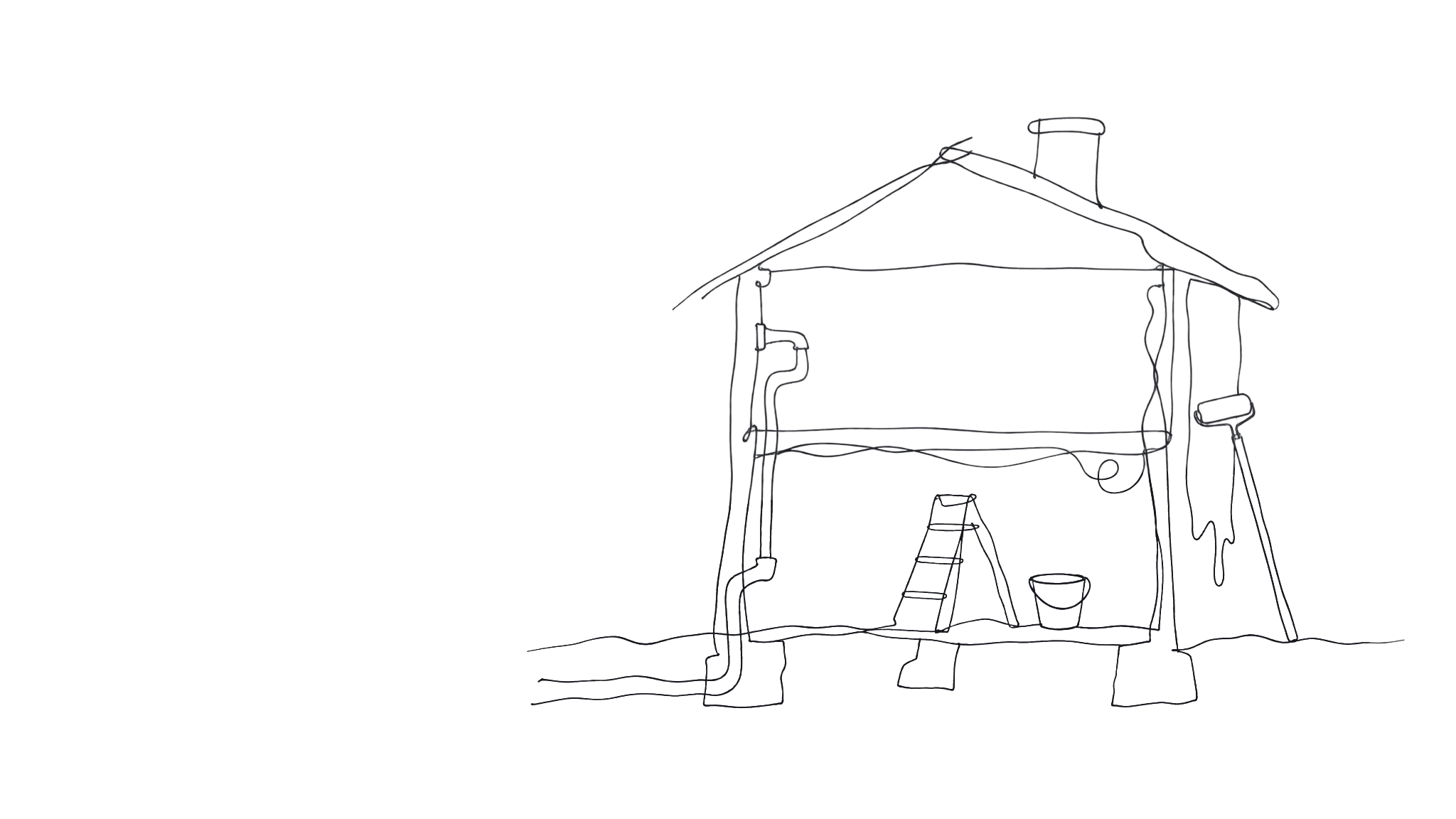
Figure 1 The same new cable in three walls. In a timber frame it’s dropped from above into one hollow bay. In plastered brick it follows the installation zones: across under the ceiling, then down beside the corner. It can be screwed onto the surface in a duct and painted over: a proper installation, quick, and the wall behind it stays as it was. In this article that stands for repainting: the new part sits on top, and nothing behind it changes. Or a channel is cut, the cable laid and the wall plastered again: slow, and the cable becomes part of the wall. That’s renovating.
A picture from house building serves for both. In America 94% of new family homes have timber frames: a new cable is pulled down through the hollow wall behind the board. In Germany about two in three residential buildings approved in 2020 were brick or other masonry: a new cable runs in a channel cut into the wall and plastered over.[3, 4, 5] A brick house is solid and built to stand. But once it needs new pipes, cables or a network, the work is heavy and slow.
Take one new cable to three walls: a timber frame, and the same plastered brick wall twice. The cable is the same in all three; only the wall decides how much work it is.
In the timber frame the cable drops from above into one hollow bay, and nothing shows. In brick it can be screwed onto the surface in a duct and painted over: quick, and the wall behind it stays as it was. The duct is sound work; what makes it repainting in this article is that nothing behind the wall changes. Or a channel is cut, the cable laid and the wall plastered again: slow, and the cable becomes part of the wall. That’s renovating.
Here the walls are the conditions a firm works under, and the cables are the connections between its systems. American walls open fast. German walls protect the people inside and are built to last, and every new opening is cut and plastered again. Political economists have names for the two kinds of country: liberal and coordinated market economies, with the United States and Germany as the standard examples. In the liberal kind a firm can hire and let people go quickly and buy its software from next door. In Germany two mechanisms matter here: protection against dismissal, which keeps the staff in the house, and co-determination, which gives them a say in the plans before the work starts.[6] The houses are only a picture of that difference. They prove nothing about software.
Inside its timber walls, T-Mobile’s wiring was as tangled as anyone’s, and it rewired while its agents went in. Telekom’s wiring in Europe is a row of old houses, each wired differently, and Telekom says so itself. The research on how firms adopt new technology sorts what speeds or slows them into three places: the technology, the organisation and the environment.[7] In Germany each has its weight: know-how that doesn’t reach the firms, laws that check a system before it runs, and technology bought from America. And the staff stay. That is what this article means by renovating: making the systems usable for software agents, so that the staff who stay are enabled by them rather than replaced by them. Section 4 shows the other route: repainting.
The order I’d follow, in brief: measure first, agree the rules with the works council, keep the choice of supplier open, train the staff, build one customer record, and hand the agent its keys one stage at a time. Then give it a team that answers for it.
What an AI system is
Figure 2 Four everyday objects for four parts of an AI system. The first is what most people picture as AI. A working system needs the other three.
The picture most people carry is one mind that understands everything and does what it’s told. What a company actually builds looks more like the equipment of a building site.
The language model is the handbook: it answers fluently from what it once read, and sometimes wrongly. Retrieval is the plans archive. The system looks up the company’s own documents first, so the answer is only as good as the archive. An agent is the handbook given keys and a job. It reads the job, does a step, looks at what happened and decides the next step, in a loop, until the job is done or it hands over to a person. It may act, not only answer, but only where its keys fit. And the cables connect it to the billing system, the customer record and the network.
The handbook can be bought. But it has to be tested on the company’s own cases before it gets any keys, and the version in use is fixed; the tests run again whenever the model, its instructions, the documents or the connections change.
The keys need the most care. They’re enforced by the systems, not by the model: the agent can only call what its connection allows, however a customer phrases the request. Customers will try to talk it into more, and some messages will carry hidden instructions, so the tests include those attempts. Tests only make such tricks rarer. What limits the damage is that the account holder confirms risky changes through a second channel, such as the app, not a text message to a number that could itself have been taken over. Every action is logged.
Everything else the company builds itself. That’s most of the work.
The American result
United States · T-Mobile US
Everything public about T-Mobile’s result comes from T-Mobile: its slides at Deutsche Telekom’s investor day and its filings with the American securities regulator. Nobody has audited them.[8, 9, 10] They’re still the best public evidence of what agents do in a large customer service. Its two headline numbers are smaller than they sound.
Figure 3 What the two headline figures count. Of 100 contacts, the release speaks of 40 without saying whose, and T-Mobile’s own slide counts 32 that start with the software. Then contacts per customer account in a year, at the two dates that are public.
United States · T-Mobile US
The 40%. Deutsche Telekom’s release says AI agents “now handle 40 percent of customer contacts” in the United States. I couldn’t find that figure in T-Mobile’s own material.[1, 9] That matters, because this is the result Telekom holds up for Europe.
T-Mobile’s customer-care slide gives 32%, and it says what it counts: contacts from contract customers that were “served by an AI agent” in the second quarter of 2026.[9] That one I could check.
These are contacts where the customer meets the software “from the beginning”, in the words of T-Mobile’s head of IT.[8] How many of them the software finished, no public source says.
The 55%. It comes from two points on T-Mobile’s slide: how often an average customer account contacts customer care in a year. At the end of 2021 that was 7.0 times, about once every seven weeks. In mid-2026 it was 3.1 times, about once every four months.[9, 11]
The agent platform was announced in September 2024, almost three years after the first point. T-Mobile names other causes for the fall too: problems fixed before customers call, and customers doing things in the app.[12, 13] Nothing is published in between, so I can’t tell how much of the fall came before the agents.
So the honest version is smaller than the headline: about a third of contract customers’ contacts start with software, and contacts per account fell by more than half between late 2021 and mid-2026, a period that includes the rewiring. It’s still a large change, and the one Telekom wants to copy.
Can Germany be measured against it? Not from outside. I put every American figure next to the nearest German one and got ten pairs, and in none of them do the two sides fully count the same thing over the same period.[9, 14, 2] The full table is in the appendix.
Timber and brick
Figure 4 Rewired against not yet rewired. T-Mobile: the share of chat conversations that never reached a person, mid-2024 and mid-2026, company figures. Telekom: the ways its customers in Europe prove who they are, and the number it plans to cut them to.
United States · T-Mobile US
T-Mobile rewired. On the rebuilt base its agents could do more, and the share of chat conversations that never reached a person rose from about a quarter in mid-2024 to 78% in mid-2026. Its head of IT told investors that the company had relied on “a largely outsourced, third-party workforce” working on systems owned by suppliers, and replaced it with its own engineers on its own systems. It built one system that holds what the company knows about each customer, and the agents read from it. A customer calling from a T-Mobile phone is recognised automatically, so the agent knows whose contract it may touch.[8, 9, 10] That’s renovating.
Germany and Europe · Deutsche Telekom
Telekom’s houses are many, and each is wired differently. Across its European countries, Telekom’s own slides say, customers prove who they are in 14 different ways, to be cut to three, and customer data sits in separate systems that still have to be made usable for agents. Above that list the slide states a principle: “Simplify before automating”.[15] Those three words are this article’s argument.
In Germany it already runs Frag Magenta, a chat and phone assistant for more than 380 kinds of request. After login it can show a bill or change the bank account on a mobile contract; otherwise it hands over to staff with a summary.[14, 8] So Telekom has started at the front desk. The wiring behind it is still separate.
German firms in general say the same about their wiring. Of those that considered AI but don’t use it, 45% named systems that don’t fit together and 44% problems with their data, close to one firm in two.[16] So it isn’t only Telekom.
This pattern has a name, the productivity J-curve, from Brynjolfsson, Rock and Syverson: like the letter J, the curve dips before it rises. A general-purpose technology pays off only after firms invest in things that don’t show up as equipment: new processes, data, skills. While that investment runs, measured productivity lags, and only later does it rise.[17] T-Mobile made that investment as part of building its agents, and its head of IT says it had to come first. The rebuilding costs money, and not all of it works out: in the third quarter of 2025, a year after the agents were announced, T-Mobile wrote off 278 million dollars, about a tenth of its net income that quarter, on parts of a billing-system replacement it abandoned.[10, 18] Telekom’s 14 ways of proving who’s calling show that in Europe this work hasn’t been done yet. In Germany I expect it to be slower.
Repainting
Figure 54 Two public cases: the saving was announced or taken from the staff first, and taken back later. Klarna froze hiring rather than cutting; at Commonwealth Bank the roles were declared redundant. Sources: Klarna; Information Age on Commonwealth Bank.
Repainting is the duct on the surface in figure 1. The duct itself is sound work; the trouble is what it leaves alone. In a company it’s an agent put in front of the customers while the wiring behind it stays as it was. It’s cheaper and faster than renovating, and from the street it looks the same for a while. But the wiring isn’t touched, so the saving has to come from somewhere. In the two cases below, it came from the people.
Klarna, a Swedish payment company, said in February 2024 that its assistant did work that, by its own estimate, equalled 700 service agents, and by then it had stopped hiring and wasn’t replacing staff who left. In May 2025 its chief executive said: “Really, investing in the quality of human support is the way of the future for us”. The company began hiring service staff again.[19, 20] That’s fifteen months from saving to reversal.
Commonwealth Bank of Australia did it faster. It said in July 2025 that 45 customer service jobs would go, replaced by a new voice bot. The union disputed the case for it, and in August the bank said its assessment “did not adequately consider all relevant business considerations”. The roles weren’t redundant after all.[21] This time, about a month.
Neither company is American or German, and two cases don’t make a rule. So why use them? Because both show the repainting route clearly. In both, the saving came from the people first, and it was partly taken back later: at Klarna over quality, at Commonwealth Bank because, the union said, the work was still there. That is repainting. In these two cases it didn’t hold.
Renovating with the staff at home
T-Mobile did more than rewire. It gave the staff who stayed an assistant of their own, whose recommendations appeared in 74% of their conversations with customers, and where they use it the net promoter score was 12% higher in May 2026.[9, 10] In the one large study I found, of 5,172 support agents, AI help raised the cases solved per hour by 15%, and by about 30% for the least experienced, twice the average gain.[22] That part is worth copying.
An American firm can also let people go while it rewires. T-Mobile booked 531 million dollars of severance by September 2026, under a 2025–2026 restructuring its filings describe as reducing organisational layers and don’t tie to the agents.[9, 10, 18] The two run side by side.
Figure 65 Every full-time position that left Telekom in Germany by an agreed route, 2021 to 2025. One mark is 50 positions. Source: Deutsche Telekom, HR Factbook 2025.
Telekom in Germany can’t take that route. Its people leave by agreed routes instead, and from 2021 to 2025 that was 20,223 full-time positions, about 4,000 a year: partial retirement, early retirement for civil servants, early retirement for other staff, severance, and transfers to public authorities.[23] Telekom agreed with the union ver.di on 28 May 2026 that there will be no dismissals for business reasons until 31 December 2028, for about 60,000 employees under its collective agreements.[24, 25] So the walls hold.
Each year’s column splits into the five agreed routes. Partial retirement is the largest every year, between about 2,100 and 2,450 positions; transfers to public authorities and early retirement for other staff are the smallest.
Severance is the route that grew: it almost doubled. So Telekom already lets about 4,000 positions a year go by agreement rather than by dismissal. Any saving from agents has to fit into those routes.
Figure 76 Three questions: two asked the same way in both countries, one across the EU. Sources: Ipsos for Google (fieldwork 2025); Ipsos AI Monitor 2025; Eurobarometer 2024 (EU only).
The staff stay while the walls are opened. And the German public is no more pessimistic about AI and jobs than the American. Asked in both countries whether AI will create or eliminate jobs, fewer Germans (61%) than Americans (67%) expected it to eliminate them.[26] That’s the public, not Telekom’s service staff. For the staff themselves, the closer evidence is the study above: AI help lifted the least experienced most.
In another survey, of 30 countries, 49% of Germans trusted their government to regulate AI responsibly, against 31% of Americans, the lowest share of all thirty.[26] Germans trust the rule-maker more.
One German result stands out: 79% saw digital monitoring of workers negatively, nearly four in five and the second-highest share in the European Union.[27] That’s the first worry a German rollout must answer.
Know-how: the organisation
Figure 87 Reasons German firms with ten or more employees gave in 2025 for not using AI after considering it. Several answers were possible; the six most named are shown. Source: Federal Statistical Office.
The first German weight sits in the organisation: people who can do the work. German firms that had considered AI but don’t use it were asked why, and most often, 72% of them, they named missing knowledge.[16] Not the law: knowledge.
The law comes next: unclear legal consequences, 62%, and data protection, 60%. Section 7 returns to both.
A survey by the European Investment Bank asked firms on both sides the same questions about generative AI. About as many European as American firms use it somewhere, 68% against 72%. The gap opens further in: 44% against 58% use it in two or more parts of the business, and 22% against 29% in customer service.[28] European firms try it almost as often; American firms more often build it into their work.
Cohen and Levinthal called the missing piece absorptive capacity, a firm’s ability to take in what others know: it can only take in outside knowledge if it already has related knowledge inside.[29] A firm without its own people who understand the wiring can buy the handbook, but it can’t install it. So training comes before the agents go live.
The law: the environment
The difference in the law is simple to state: in America the checks on a system like this come after launch, in Germany before it. Car approval works the same way. In America the maker certifies a new car’s safety itself and the regulator can force a recall later, while in the EU an authority approves the type before any car is sold.[30, 31] Same car, different order.
Figure 98 One decision, two schedules: in the United States the checks come after launch, in Germany before it. Since 2021 a framework agreement shortens the German route.
United States · T-Mobile US
At T-Mobile the checks came after. In T-Mobile’s public material I found no check by staff before launch, though that doesn’t prove there was none. T-Mobile announced its agent platform in September 2024, and about 21 months later a third of contract customers’ contacts started with it. A works council in the German sense doesn’t exist there: a staff body that T-Mobile had set up itself was ordered dissolved, and a federal appeals court upheld that in January 2024. Other checks come later, as lawsuits and state rules.[12, 9, 32, 33, 34, 35] No staff check that I could find; every check I found comes after launch.
Germany · Deutsche Telekom
At Telekom the works council, elected by the staff, has to be told while the system is still being planned; since 2021 the law names AI expressly. If a system is suited to monitoring staff, the works council has to agree under § 87(1) no. 6 of the Works Constitution Act, and a screen that listens to service calls very likely is. Telekom’s own privacy and security experts approve a system before it runs, and the data protection regulation requires an impact assessment before risky processing.[36, 37, 38, 39, 40] Three checks, all before launch.
Telekom has had a shortcut since 2021, the way an approved car type covers every car built to it. Before, its works council’s IT committee took six weeks per case, sometimes with more than a hundred cases in one meeting. After a pilot that began in 2018, a group agreement in March 2021 set the rules once. Now a department fills in a profile of its system, the company and the works council check it against the agreed rules, and if nothing goes beyond the rules no separate decision is needed.[41, 37, 38] The same model would suit the agents.
The rules are short: no control of individual performance or behaviour, evaluations only for anonymised groups of more than five, logs only for data protection and IT security.[41] The bigger problem is a screen that listens to calls. It probably goes beyond the rules and needs its own approval, and if the works council refuses a system, a conciliation board decides, which adds a procedure of its own.[37, 38] How long does that take? I couldn’t find the agreements that would show it.
Under the AI Act, customers must be told since 2 August 2026 when they deal with an AI system, and from 2 December 2027 a tool used to monitor or evaluate employees can count as high risk.[42, 43] Firms feel the weight: unclear legal consequences and data protection were the second and third reasons in section 6.[16] So the work has to be planned for the checks. In Germany they come first.
Dependence: the technology
Germany and Europe
The third weight is technology bought from America. In a Bitkom survey of 605 German firms with 20 or more staff, published in November 2025, 51% called themselves strongly dependent on the United States for the digital technology they import.[44] That is half, by their own account.
Germany · Deutsche Telekom
Telekom is better placed than almost any German firm. It has run an AI factory in Munich since February 2026, with nearly 10,000 graphics processors, which it sells to industrial customers. For its own staff it still uses OpenAI models in its internal assistant and is rolling out 120,000 OpenAI licences. Which model runs Frag Magenta, I couldn’t find out.[45, 46, 8, 15] If even Telekom reaches for American materials for its own house, firms without a factory of their own will do so all the more.
That is a dependency. A house built from one foreign supplier’s parts is at that supplier’s mercy: it sets the price, the delivery dates and the rules for what may be stored where. Telekom describes its European platform as able to switch between models.[47] That switch, more than the choice of any single model, is what limits the dependency. Untested, that switch is only a claim.
The renovation, in order
Telekom’s own target is 2030. What I couldn’t find in its public plan is the order, or dates for the work in the walls. So here is mine. It isn’t copied from T-Mobile, because T-Mobile’s sequence can’t be shown to have caused its result; it follows from what each step needs from the one before. It’s a hypothesis. The measure in step 1 shows whether the programme works, and whether the order matters could be tested by comparing countries or units that reach step 5 at different times.
The frames from the earlier sections each point to a step. The J-curve puts the rewiring before the return: step 5, and the staged keys of step 6 that build on it. Absorptive capacity puts people’s learning before the tools: step 4. A coordinated economy settles the rules with the staff first, in step 2, and the three German weights each have their step too: the law in step 2, dependence in step 3, know-how in step 4. Hall and Soskice also argue that coordinated economies are better at incremental than at radical innovation.[6] If they’re right, slow, incremental work is what German firms are good at. Renovating plays to that strength.
- Measure first. One measure for both countries, with its cost: requests finished without a person that didn’t come back within a week, set against what the agent costs to build and run. Without it, nobody can check the 2030 target. Measure: the pair is published.
- Works agreement. The framework is agreed while the system is planned, not after it’s built, with an annex for each new key, so it isn’t renegotiated every time. Evaluations of staff data from the agent’s systems cover only anonymised groups of more than five, and logs about staff serve only data protection and IT security, as Telekom’s 2021 framework already requires. That’s the answer to the monitoring worry, written down before launch. The AI Act dates in section 7 set the latest deadlines.[37, 42, 43] Measure: signed before the first agent acts.
- Choose suppliers. Keep the switch between model suppliers: in the contract, with exit terms, and in the design, with a layer between Telekom’s systems and the model and a second model kept under test. Keep sensitive customer data on hosting Telekom controls in Germany. A switch means testing again, so its real length includes the tests and the works council’s review.[47] Measure: time to switch, tests included.
- Train staff. The service staff who stay learn the new tools before the tools reach customers, starting with the least experienced, for whom the measured gain is largest.[22] Measure: cases per hour and repeat contacts.
- One customer record. Cut the 14 ways of proving who’s calling to three and make the customer data usable before agents act on accounts: Telekom’s own “simplify before automating”, with a date.[15] It’s the biggest job here. One system becomes the master record; the agent reads and writes only through it, and a named team settles conflicts between old systems. Every later step depends on it, since an agent can’t act on an account it can’t identify. It takes years and can fail: T-Mobile wrote off 278 million dollars. Agent pilots that change accounts in parallel are a risk: their systems are about to change. Measure: callers recognised without questions.
- Permissions in stages. First the agent only reads: show a bill, check an order. For customers who have logged in, this first stage needn’t wait for step 5. Then actions that can be undone, such as restarting a line. Changes that fraud could use come last, with a confirmation from the customer and a named person who answers for that kind of action. Before each stage the agent runs alongside the staff without acting, then passes a test set of real past cases, each labelled with the right outcome by experienced staff. Frag Magenta can already change the bank account on a mobile contract after login.[14] It is the natural first case for the staged review. Measure: errors per thousand actions, stage by stage.
- Acceptance. Before the agent works on its own, the service staff who’ll work beside it and the works council sign it off. The staff have already worked next to it in step 6. Measure: accepted by both.
- Run it. A named team answers for the agents, nights included. It owns monitoring of cost and errors, the fallback to staff when the agent or a connection is down, and every release and rollback. How many people that takes isn’t public; step 6’s stages would show. Weekly, it reviews sample conversations and counts reversed actions and complaints. It can send the agent back a stage at once, and every change of model or instructions is a release, tested again. It watches the cost of each finished request like the electricity bill and feeds what it finds into step 1’s measure. Measure: cost per finished request.
Figure 10 The renovation in eight steps, in the order each one needs the one before. The steps stay in Germany’s walls: the staff stay, the works council agrees first, and every key is tested before it’s handed over.
1 · Measure first. One measure for both countries, with its cost: requests finished without a person that didn’t come back within a week, set against what the agent costs to build and run. Without it, nobody can check the 2030 target. Measure: the pair is published.
2 · Works agreement. The framework is agreed while the system is planned, not after it’s built, with an annex for each new key, so it isn’t renegotiated every time. Evaluations of staff data from the agent’s systems cover only anonymised groups of more than five, and logs about staff serve only data protection and IT security, as Telekom’s 2021 framework already requires. That’s the answer to the monitoring worry, written down before launch. The AI Act dates in section 7 set the latest deadlines.[37, 42, 43] Measure: signed before the first agent acts.
3 · Choose suppliers. Keep the switch between model suppliers: in the contract, with exit terms, and in the design, with a layer between Telekom’s systems and the model and a second model kept under test. Keep sensitive customer data on hosting Telekom controls in Germany. A switch means testing again, so its real length includes the tests and the works council’s review.[47] Measure: time to switch, tests included.
4 · Train staff. The service staff who stay learn the new tools before the tools reach customers, starting with the least experienced, for whom the measured gain is largest.[22] Measure: cases per hour and repeat contacts.
5 · One customer record. Cut the 14 ways of proving who’s calling to three and make the customer data usable before agents act on accounts: Telekom’s own “simplify before automating”, with a date.[15] It’s the biggest job here. One system becomes the master record; the agent reads and writes only through it, and a named team settles conflicts between old systems. Every later step depends on it, since an agent can’t act on an account it can’t identify. It takes years and can fail: T-Mobile wrote off 278 million dollars. Agent pilots that change accounts in parallel are a risk: their systems are about to change. Measure: callers recognised without questions.
6 · Permissions in stages. First the agent only reads: show a bill, check an order. For customers who have logged in, this first stage needn’t wait for step 5. Then actions that can be undone, such as restarting a line. Changes that fraud could use come last, with a confirmation from the customer and a named person who answers for that kind of action. Before each stage the agent runs alongside the staff without acting, then passes a test set of real past cases, each labelled with the right outcome by experienced staff. Frag Magenta can already change the bank account on a mobile contract after login.[14] It is the natural first case for the staged review. Measure: errors per thousand actions, stage by stage.
7 · Acceptance. Before the agent works on its own, the service staff who’ll work beside it and the works council sign it off. The staff have already worked next to it in step 6. Measure: accepted by both.
8 · Run it. A named team answers for the agents, nights included. It owns monitoring of cost and errors, the fallback to staff when the agent or a connection is down, and every release and rollback. How many people that takes isn’t public; step 6’s stages would show. Weekly, it reviews sample conversations and counts reversed actions and complaints. It can send the agent back a stage at once, and every change of model or instructions is a release, tested again. It watches the cost of each finished request like the electricity bill and feeds what it finds into step 1’s measure. Measure: cost per finished request.
Until the end of 2028 the return has to come from fewer repeat contacts, from staff moving to work software can’t do, and from customer service’s share of the roughly 4,000 who leave each year by the agreed routes.[24, 23] That’s managed attrition and voluntary exits, not repainting: nobody is removed to book the saving, and positions are left unfilled only once the agent has shown it carries the work.
Telekom can’t import T-Mobile’s 32%. But it can copy the slow work behind it: one customer record, and callers recognised without being asked who they are. That’s the renovation. The order is my hypothesis, not T-Mobile’s.
Where this could be wrong
The analogy simplifies. One in five German residential buildings approved in 2020 was already timber, many German firms run modern systems, and software walls, unlike brick, can be rebuilt completely.[4] I use the houses for one property only: how hard it is to add a new connection to what already stands.
Three findings would show that my argument is wrong. If Telekom reports a German figure built like T-Mobile’s 32% before its work on authentication and customer data is finished, the customer record mattered less than I claim. If staff numbers in customer service fall faster than the agreed routes allow, the staff are leaving after all. And if a works agreement for the service systems is published with its dates and shows months of delay, the law is a bigger weight than I give it here.
What I couldn’t show from public sources: that the agents alone caused the fall in American service contacts; that any approval delayed a Telekom service system, or that none did; which model runs Frag Magenta and where; and how many of the positions that left, on either side, were in customer service. I spoke to no one at either company. Everything here is public.
How this was made
Show how this was madeHide the details
The question, the argument and the choice of the case are mine. The picture of timber and brick houses is my father’s: he’s a civil engineer. I used AI assistants to find and open sources (company reports and slides, filings, legal texts, official statistics, published studies), to draft passages from my notes and dictations, and to check every claim against its source. AI critics, each reading as someone else (a professor, an engineer, a practitioner, a reader with no background), went through the drafts, and I fixed what they found wrong. Every claim carries its source number; on screen, select the mark to open the source. The numbers behind the figures are published with the article’s code, as JSON files: github.com/THD-AI/ws27-papers. I decided what stays.
Sources (47)
Show the 47 sourcesHide the sources
- 1Deutsche Telekom boosts growth, efficiency and quality through the use of AI (opens in a new tab)
- 2AI Investor Day, CEO slides (opens in a new tab)
- 3Wood framing continues to dominate single-family construction (Census Survey of Construction, 2025 completions) (opens in a new tab)
- 4Baugenehmigungen 2020 nach überwiegend verwendetem Baustoff (Destatis, reported by Baulinks) (opens in a new tab)
- 5Leitungsverlegung und Installationszonen (DIN 18015-3) (opens in a new tab)
- 6Varieties of Capitalism: The Institutional Foundations of Comparative Advantage (opens in a new tab)
- 7The Processes of Technological Innovation (the technology–organisation–environment framework); summarised in J. Baker, "The Technology–Organization–Environment Framework", Information Systems Theory, 2012 (opens in a new tab)
- 8Deutsche Telekom AI Investor Day (Oct. 5, 2026) Transcript (opens in a new tab)
- 9AI Investor Day deck (opens in a new tab)
- 10Annual Report on Form 10-K for FY2025 (opens in a new tab)
- 11Form 8-K, Exhibit 99.1, “T-Mobile Raises the Bar, Increasing its Multi-Year Growth Outlook...” (opens in a new tab)
- 12T-Mobile and OpenAI Join Forces to Revolutionize the Customer Experience with First-Ever Intent-Driven AI-Decisioning Platform (opens in a new tab)
- 13T-Mobile (TMUS) Q3 2026 Earnings Call Transcript (opens in a new tab)
- 14Unser Chatbot hilft rund um die Uhr (opens in a new tab)
- 15AI Investor Day, “From AI Adoption to AI Impact” (opens in a new tab)
- 16Gruende gegen die Nutzung von Technologien der kuenstlichen Intelligenz nach Beschaeftigtengroessenklassen, 2025 (opens in a new tab)
- 17The Productivity J-Curve: How Intangibles Complement General Purpose Technologies. American Economic Journal: Macroeconomics 13(1), 333–372 (opens in a new tab)
- 18Quarterly Report on Form 10-Q, Q3 2026 (opens in a new tab)
- 19press release on the AI assistant's first month, 27 February 2024 (opens in a new tab)
- 20Klarna hires service agents again, 9 May 2025 (opens in a new tab)
- 21CBA reverses AI-driven job cuts, admits "error" (opens in a new tab)
- 22Generative AI at Work (opens in a new tab)
- 23HR Factbook 2025, “Socially responsible staff reduction” (opens in a new tab)
- 24Deutsche Telekom und ver.di erzielen Tarifeinigung (opens in a new tab)
- 25Tarifergebnis Deutsche Telekom: mehr Entgelt, Kündigungsschutz und erstmals Mitgliederbonus (opens in a new tab)
- 26AI Index Report 2026, chapter 9, “Public Opinion” (opens in a new tab)
- 27Special Eurobarometer 554, Artificial Intelligence and the future of work (opens in a new tab)
- 28EIB Group Investment Survey 2026 - European Union overview (opens in a new tab)
- 29Absorptive Capacity: A New Perspective on Learning and Innovation. Administrative Science Quarterly 35(1), 128–152 (opens in a new tab)
- 30Notice regarding the applicability of NHTSA FMVSS test procedures to certifying manufacturers (85 FR 83143) (opens in a new tab)
- 31Regulation (EU) 2018/858 on the approval and market surveillance of motor vehicles and their trailers (Art. 6(4), recital 40) (opens in a new tab)
- 3229 U.S.C. § 158 (NLRA section 8) (opens in a new tab)
- 33U.S. Court of Appeals Rejects T-Mobile's Baseless Attempt to Reverse NLRB Ruling... (opens in a new tab)
- 34California Finalizes Regulations to Strengthen Consumers' Privacy (opens in a new tab)
- 35U.S. Federal Court Allows CIPA Class Action Against AI Customer Service Provider to Proceed (opens in a new tab)
- 36Betriebsverfassungsgesetz § 90 (opens in a new tab)
- 37Betriebsverfassungsgesetz § 87 (opens in a new tab)
- 38Betriebsverfassungsgesetz § 76 (opens in a new tab)
- 39Privacy and Security Assessment (opens in a new tab)
- 40Regulation (EU) 2016/679 (GDPR), Art. 22, 35, 36, 38 (opens in a new tab)
- 41Gute IT digital mitbestimmen (2022). Portrait über beschleunigte Mitbestimmungsverfahren und digitale Zusammenarbeit bei der Deutschen Telekom AG (opens in a new tab)
- 42Regulation (EU) 2024/1689 (AI Act) (opens in a new tab)
- 43Regulation (EU) 2026/1744 (Digital Omnibus on AI), amending the AI Act (opens in a new tab)
- 44Europas Weg in die digitale Souveränität (opens in a new tab)
- 45Germany's first AI factory for industry officially goes into operation in Munich (opens in a new tab)
- 46Annual Report 2025, Management report, Group strategy, “Data & AI” (opens in a new tab)
- 47AI Investor Day, “AI in Customer Interactions” (opens in a new tab)
Appendix: the ten pairs
Every American figure next to the nearest German one. A pair could be compared if both sides counted the same thing, in the same period, in the same way.
Show the ten pairsHide the ten pairs
| What is counted | T-Mobile US | Telekom, Germany | Why they do not compare |
|---|---|---|---|
| Fewer contacts | > 55% | 50–55% | achieved against target; per account against absolute |
| Chatbot success | 78% | > 1/3 | not reaching a person is not the same as resolved |
| Help for staff | 74% | > 12,000 | both assist people; different measures |
| Done digitally | > 80% | up to 70% | different transactions; achieved against target |
| Satisfaction | 46 | > 67 | two different scores |
| Profit effect | ≈ $3 bn | ≈ €2.5 bn | profit uplift against gross savings; scope and base year differ |